| Product: | PriboFast®Aflatoxin M1 ELISA Kit |
| Product Number: | EKT-012H-48T |
| Lot: | Z2F00G03. |
| Manufacture Date: | 2026-07-21 |
| Expiry Date: | 2027-07-20 |
| Storage Conditions: | 2-8℃ |
General Information
Aflatoxins are toxic metabolites produced by molds such as Aspergillus flavus and Aspergillus parasiticus.
Aflatoxin M₁ is a hydroxylated metabolite of aflatoxin B₁. It is commonly found in the milk of dairy cows that have
consumed feed contaminated with aflatoxin B₁. Because aflatoxin M₁ is relatively stable and cannot be
completely eliminated by pasteurization, monitoring should be performed not only in feed materials but also in
final dairy products.
Analytical methods for the determination of aflatoxin M₁ include high-performance liquid chromatography (HPLC),
thin-layer chromatography (TLC), and enzyme-linked immunosorbent assay (ELISA). Among these methods, this
ELISA kit provides a rapid and accurate approach and is suitable for the analysis of milk, yogurt, cheese, and milk
powder matrices.
Test Principle
This kit is based on an indirect competitive ELISA method. The microplate wells are pre-coated with aflatoxin M₁
antigen. During the assay, aflatoxin M₁ present in the sample competes with the coated antigen for binding to the
specific anti-aflatoxin M₁ antibody. Subsequently, an enzyme-labeled secondary antibody binds to the primary
antibody. After the addition of the TMB substrate, a color reaction occurs. The absorbance value of the sample is
inversely proportional to the concentration of aflatoxin M₁ present. The concentration of aflatoxin M₁ in the
sample is determined by comparison with the standard curve and multiplication by the corresponding dilution
factor.
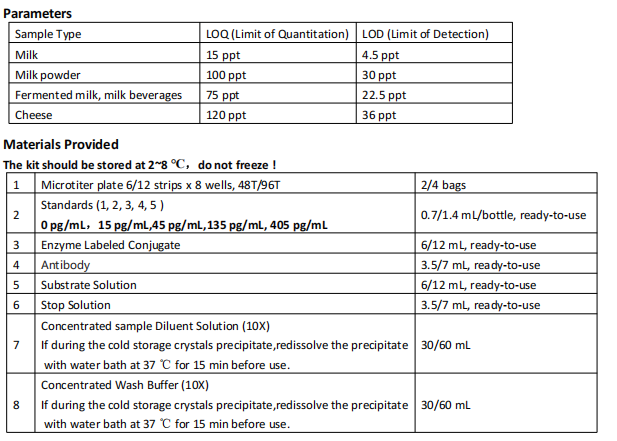
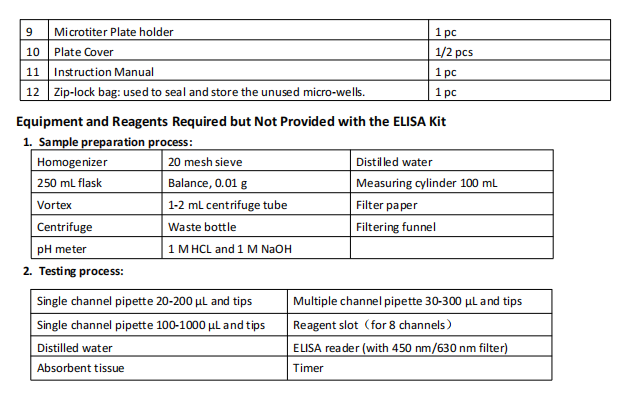
Reagent Preparation
1. Wash buffer working solution : dilute the concentrated wash buffer (10×) to 1× with distilled water
(Concentrated wash buffer : water = 1: 9).
2. Sample Diluent Buffer : dilute the concentrated sample diluent solution (10×) to 1× with distilled water
(Concentrated sample Diluent Solution (10×) : water = 1: 9).
Precautions
1. Recovery the reagents and strips to room temperature (20~25 ℃) before use.
2. Put the reagent back to 2~8 ℃ instantly after use.
3. The reproducibility of ELISA analysis depends largely on the consistency of the washing step, and the correct
operation of the washing step is the key point of ELISA procedure.
4. Cover the micro-wells with plate cover membrane in each constant temperature incubation step, to avoid
exposure the reaction system to a direct sunlight.
Sample Preparation Procedures
Milk:(sample dilution ratio: 1)
Fresh milk or finished milk samples were taken and placed at 25℃ for about 1h, and the samples were directly
tested after full temperature return.
Milk powder:(sample dilution ratio: 7)
1. Weigh 1.0 g samples and dissolve them in 7 mL distilled water (heat can be used to help dissolve).
2. Direct detection after oscillation mixing.
Fermented milk/Milk beverage:(sample dilution ratio: 5)
Sample 1.0 g was taken, 4 mL sample diluent was added, and the samples were oscillated and mixed for 2 min for
direct detection (stratification would occur during the placement of fermented milk samples, and the samples
could be shaken well before sampling)
Cheese:(sample dilution ratio: 8)
1. Weigh 0.5 g sample and dissolve it in 4 mL sample diluent.
2. Violently oscillating for 5 min (it can be heated to promote dissolution), centrifuging for 5 min at 4000 r/min,
removing the upper lipid film, and taking the intermediate layer for detection.
If the targets concentration of sample solution exceeds the detection range(showed in calculation template) of
this kit, the sample to be measured should be further diluted. Additional dilution due to high sample
concentration should be considered in calculation.
Assay Procedure
1. Prepare samples as described above.
2. Pipette 50 µL standards or prepared samples in duplicate into the corresponding wells of the microplate. Add
50 µL of the AFM
1
antibody into each well.Cover and incubate for 30 min at room temperature.
3. Wash the plate for three or four times as follows: remove the plate cover membrane,discard the contents of
the wells (dump or aspirate). Pipette 300 µL of prediluted washing solution into each well. After the third
repetition empty the wells again and remove the residual liquid by striking the plate against a paper towel. The
wash procedure is critical. Insufficient washing will result in poor precision and falsely positive result.
4. Add 100 µL of AFM
1
enzyme conjugate to each well. Cover and incubate for 15 min at room temperature.
5. Wash the plate three or four times same as the step #3.
6. Add 100 μL of substrate solution to each well. Cover and incubate for 15 min in room temperature. Cover the
wells with a paper towel to protect them from light sources.
7. Stop reaction by adding 50 µL of stop solution into each well. The blue colour will turn yellow upon addition.
8. Shake the plate gently to mix well, measuring OD of each well at 450 nm(or 630 nm) with an ELISA
reader,using an ELISA reader. The colour is stable for 10 min.
Results Analysis
1. Process the sample as procedures above, the dilution ratio should be accounted for in calculation. Additional
dilution induced due to high sample concentration has to be accounted for in calculation too.
2. Note: Pribolab has a specific data processing software, if necessary, please request through the official email:
Cautions
Full compliance of the following good laboratory practices (GLP) will determine the reliability of the results:
1. Prior to beginning the assay procedure, bring all reagents to room temperature (20~25°C).
2. All reagents should be mixed by gentle inversion or swirling prior to use. Do not induce foaming.
3. Once the assay has been started, all subsequent steps should be completed without interruption and within the
recommended time limits.
4. Replace caps in all the reagents immediately after use. Do not interchange vial stoppers.
5. Use a separate disposable tip for each specimen to prevent cross-contamination.
6. All specimens and standards should be run at the same time, so that all conditions of testing are the same.
7. Do not mix components from different batches.
8. Do not use reagents after expiration date.
9. Check both precision and accuracy of the laboratory equipment used during the procedure(micropipets, ELISA
reader etc.).
10.The standard provided in this kit is only intended for the preparation of the standard curve and should not be
used for other purposes.
Storage and guarantee period
The kit should be stored at 2~8 ℃.
Guarantee period: the shelf life of concentrated wash buffer, concentrated sample dilution buffer and substrate
solution is 24 months. The shelf life of stop solution is 36 months. The shelf life of other components is 12
months.
Pribolab Biotech Co.,Ltd.
China Office: Building 21, MAX Business Hongwan, High-tech Zone, Qingdao
Website: www.pribolab.com
No comments yet. 登录后发起新讨论 发起新讨论